Overview
Two everyday frustrations, one underlying brief.
The team was tasked with looking into how to improve functionality for all users across CANAL+'s leanback TV experience. Out of that broader brief, I was assigned two specific concepts: Mobile Companion and Hand Gestures.
Both concepts trace back to the same root problem: the remote control and on-screen keyboard are the two most friction-heavy parts of watching TV. And both solutions ended up doing double duty: improving the experience for everyone, while also meaningfully improving accessibility for users who struggle with fine motor control or on-screen typing.
Problem
The remote and the keyboard were both working against people.
⌨️
Typing on a TV is painfully slow
Entering a search query with a directional remote and an on-screen keyboard takes far longer than typing or speaking on a phone people already carry.
🎮
The remote is a barrier, not just an inconvenience
For users with limited dexterity, holding and operating a small multi-button remote is a genuine access barrier, not simply a mild annoyance.
♿
Accessibility wasn't being designed for directly
Existing improvements to the interface focused on convenience for the average user, without deliberately addressing fine motor or dexterity constraints.
Research — Heuristic Evaluation
Grounded in evaluation, not assumption.
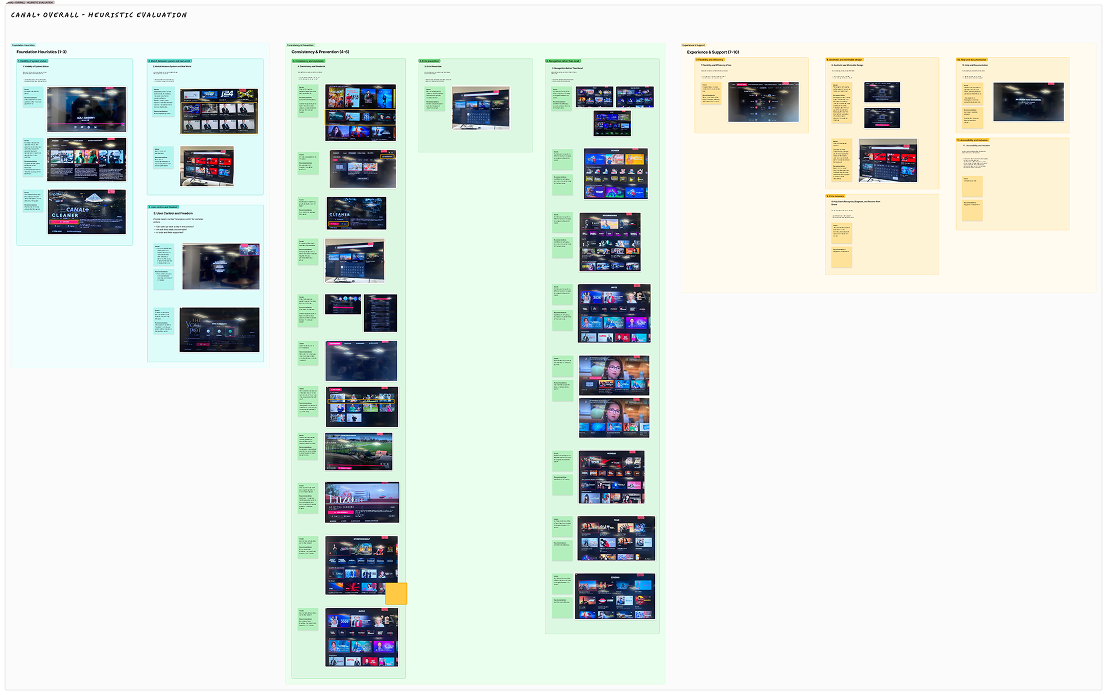
Before proposing solutions, I conducted a heuristic evaluation of the CANAL+ leanback experience, reviewing the existing interface against established usability principles. The evaluation surfaced issues across six areas:
🗣️
Language & terminology inconsistency
Mixed French and English across the interface, inconsistent terms between platforms (e.g. "Programme TV" on leanback vs "TV Guide" on web), and unclear labels like "Rewatch." This directly informed the need for consistent, predictable labelling in both concepts.
🧩
UI consistency issues
Inconsistent button labels ("Play" vs "Watch"), duplicate content cards, and a mic icon that appears outside the search bar in some views, a direct precursor to the Mobile Companion search concept.
🧭
Navigation & discoverability
No sports subcategory filters, poor visual hierarchy in menus, and a keyboard focus trap on search that makes it hard for users to exit, a clear, specific motivation for moving search input off the remote entirely.
📡
Feedback & system status visibility
No clear watched/unwatched indicators, unclear progress bars, no visual pause indicator, and occasional unexplained blank screens during playback.
🚧
Error handling & recovery
Repetitive generic error messages ("An error has occurred") with no guidance on recovery, and blank screens appearing without any error messaging at all.
🎙️
Interaction & control limitations
Users can't deselect a rating, only change it, and voice search availability is inconsistent across devices, with the mic icon sometimes appearing active even when voice search isn't supported, directly shaping how Mobile Companion needed to communicate availability clearly.
Research: UI/UX Trends
Looking at how others were solving the same problem.
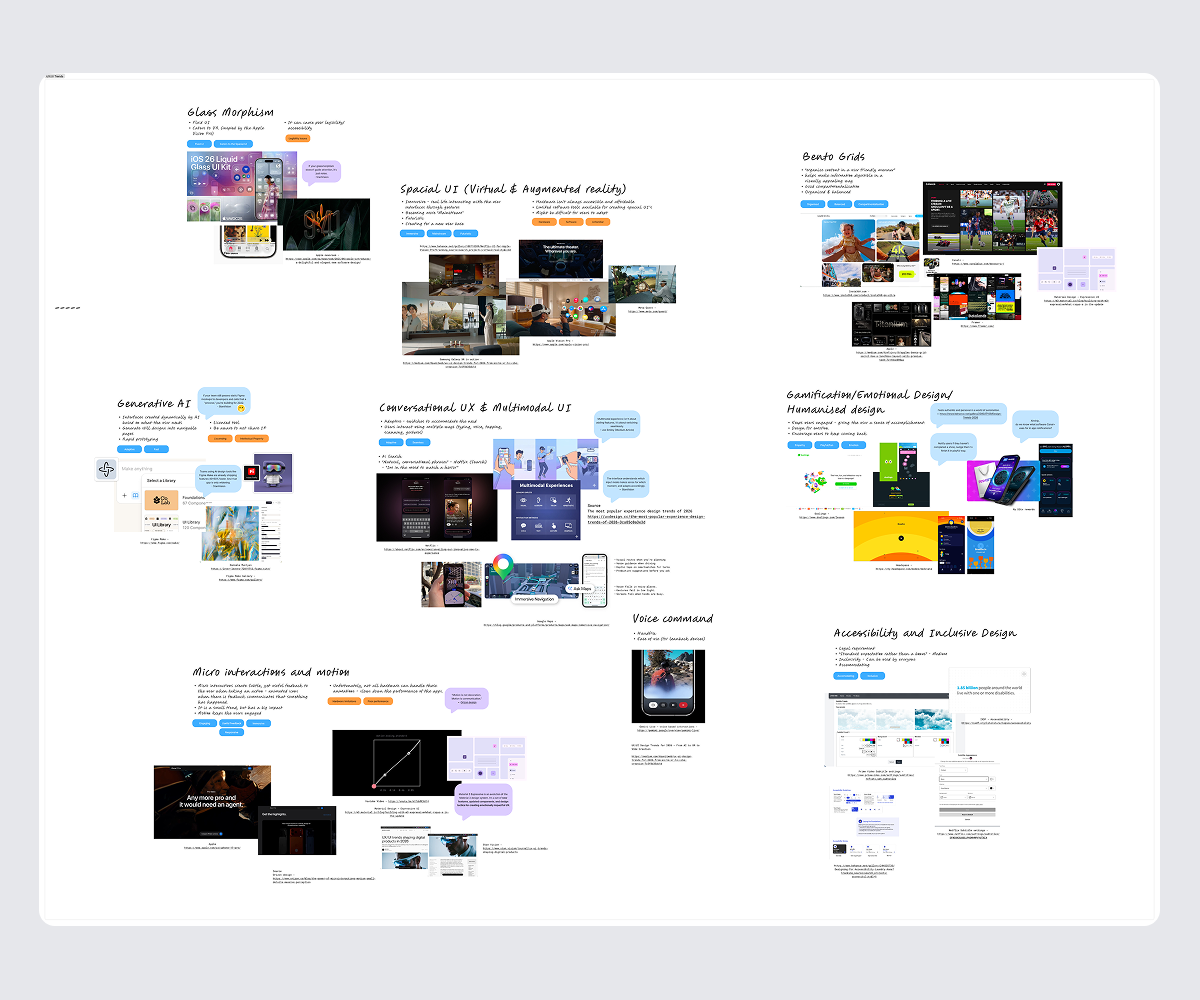
Alongside the heuristic evaluation, I researched current UX and UI trends relevant to leanback and connected-device experiences:
UX trends: AI-powered personalisation, proactive/anticipatory UX, no-UI or invisible interfaces, multimodal interaction spanning voice, gesture, and touch, accessibility-first UX, and emotionally intelligent UX. The multimodal and accessibility-first principles map directly onto Mobile Companion and Hand Gestures as concepts.
UI trends: micro-interactions and motion, gamification and emotional design (the kind that keeps people coming back, as seen in products like Duolingo), spatial UI for virtual and augmented reality, voice command, and accessibility and inclusive design.
Research: UX Research & App Store Reviews
What users told us directly, and what they told the world.
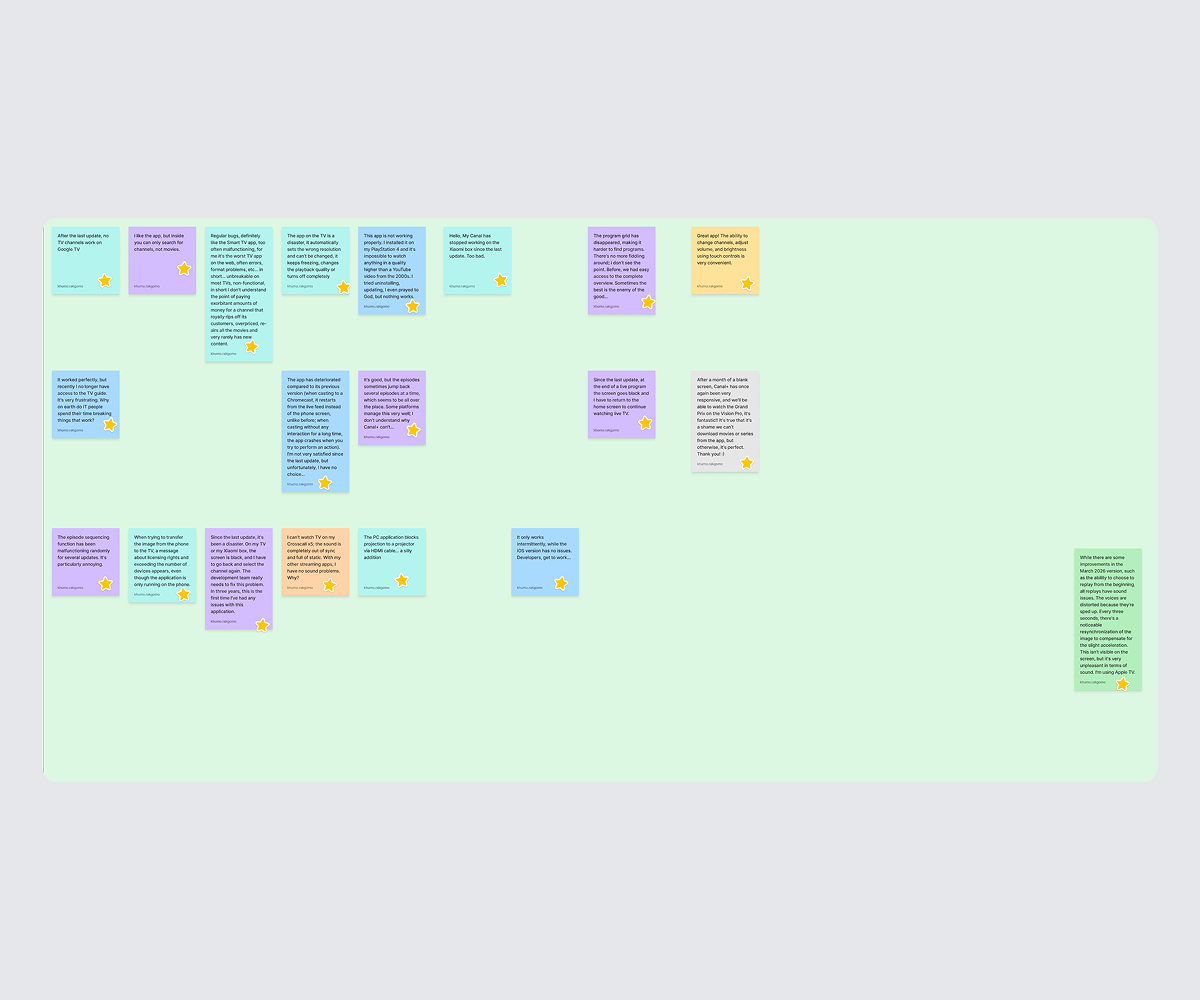
A discovery study and a review of public app store feedback gave two complementary views of the same underlying experience, one from guided conversations, one from unprompted public complaints.
UX research: The discovery research found that TV is mainly a social, cozy activity often shared with family or roommates, and that users frequently multitask, treating TV as background and focusing only on key or emotional moments. CANAL+ was appreciated for its intuitive, consistent cross-device experience and its nostalgic, familiar content. Pain points included limited original-audio or English subtitle availability, occasional buffering, and abrupt disconnections from account sharing, with one user explicitly wanting smarter, more personalised recommendations. The desired experience centred on hands-free, immersive viewing, a unified experience across devices with easy language and subtitle controls, and reliable casting and device handoff.
App store reviews: These reviews echoed and sharpened the same themes at scale: widespread technical failures including multiple error codes blocking live TV access, frequent crashes requiring cache clears or reinstalls, and video quality complaints capped as low as 240p with constant buffering. Users reported broken search functionality and missing content discovery features, playback that failed to resume or remember progress, and authentication issues including accounts locked without explanation. The search and discovery complaints in particular reinforced the case for Mobile Companion as a faster, more reliable way to find content than the existing on-screen search.
Process
Two concepts, evaluated against the same criteria.
With the research pointing at two distinct friction points, search input and remote control, the process branched into two parallel concepts rather than forcing a single solution to cover both. Each concept was evaluated against the same two questions: does this meaningfully reduce friction for everyone, and does it specifically help people excluded by the current remote-first design?
Process: Wireframes
From research findings to early structure.
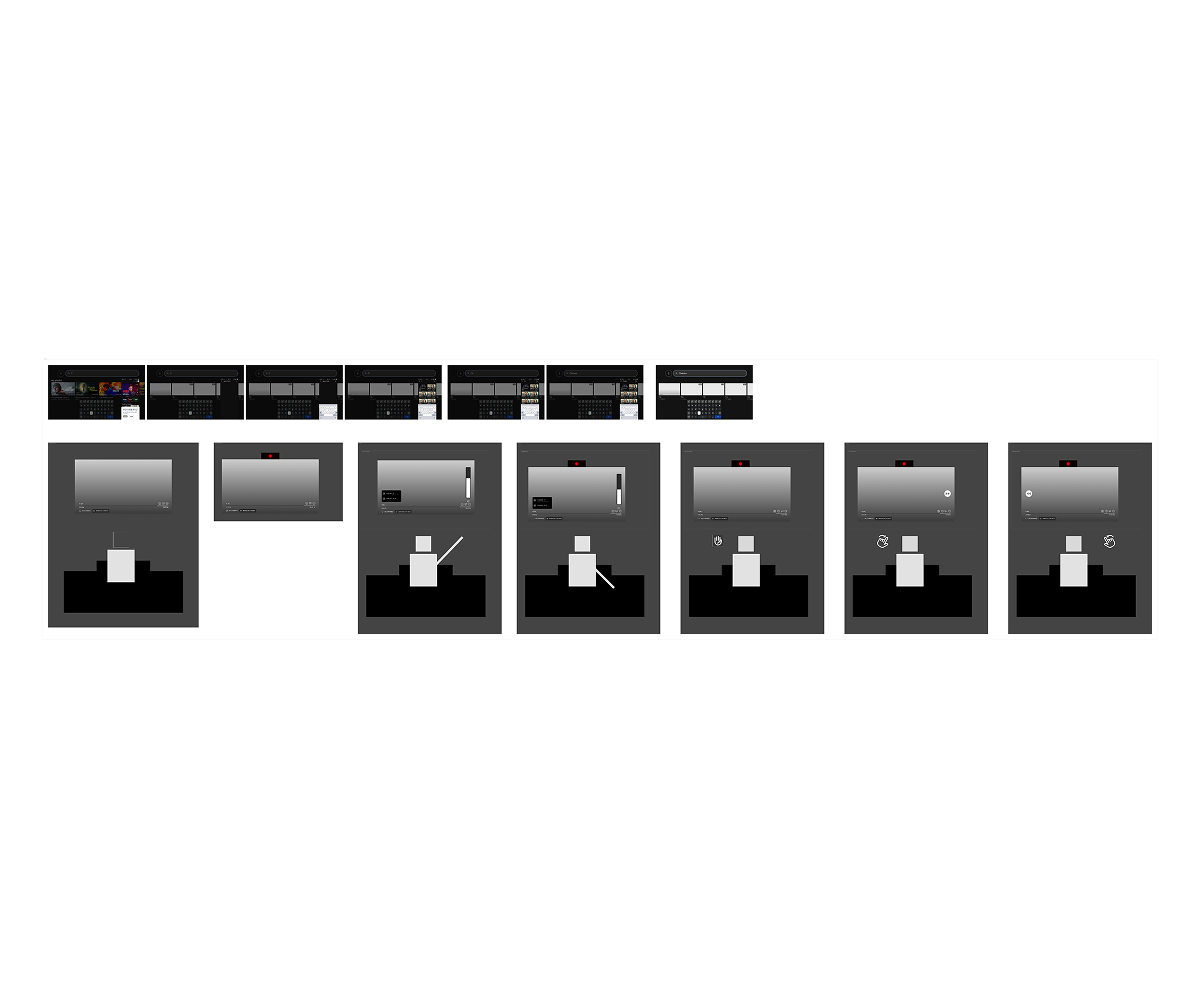
With the friction points and direction confirmed, wireframes for both Mobile Companion and Hand Gestures mapped out the core flows at a low level of fidelity, the notification handoff, the search input screen, and the gesture recognition states, before any visual design work began.
Solutions — Concept 1: Mobile Companion
Nobody wants to type a show title with a remote.
Typing long search queries using a directional remote and an on-screen keyboard is slow and frustrating, every letter is a deliberate, multi-click action. Mobile Companion solves this by moving the typing (or speaking) off the TV entirely.
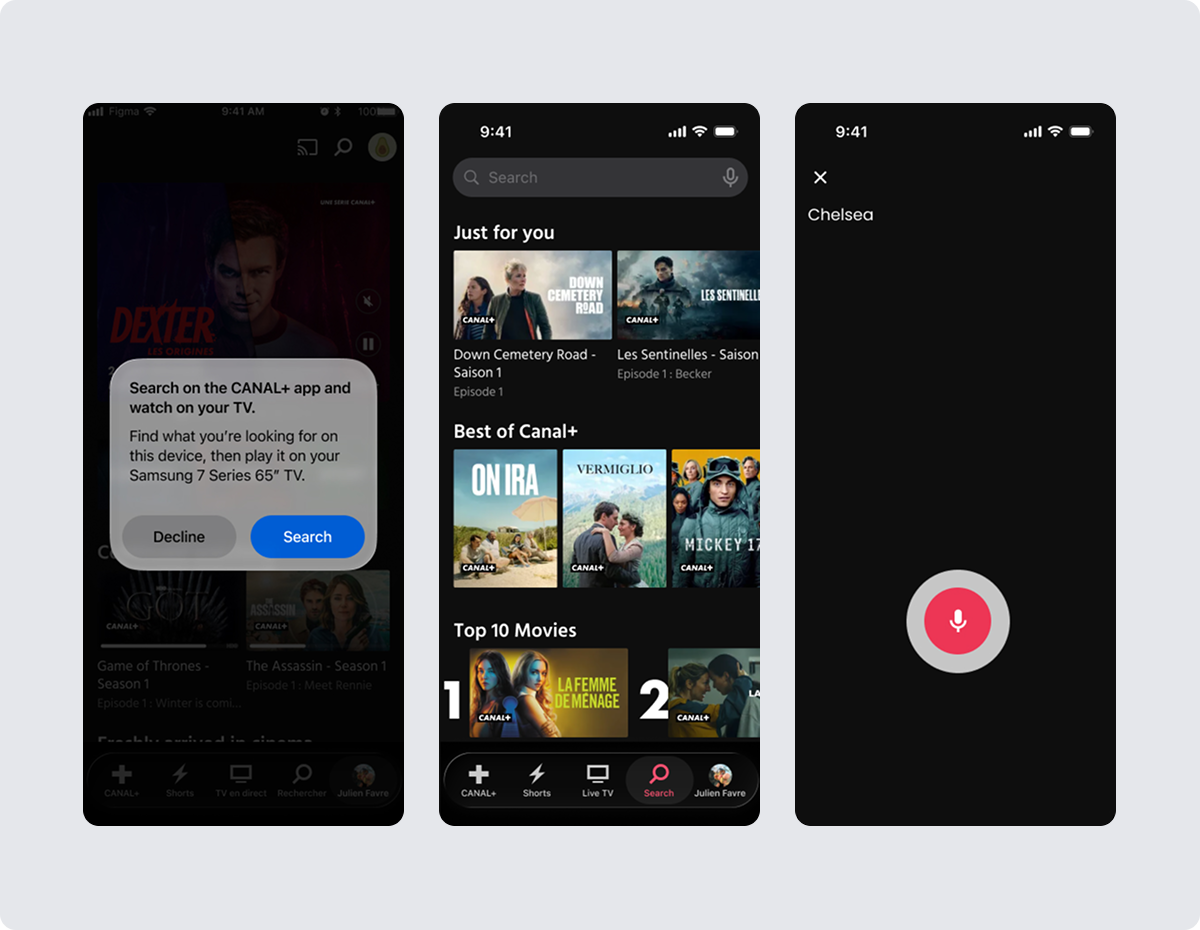
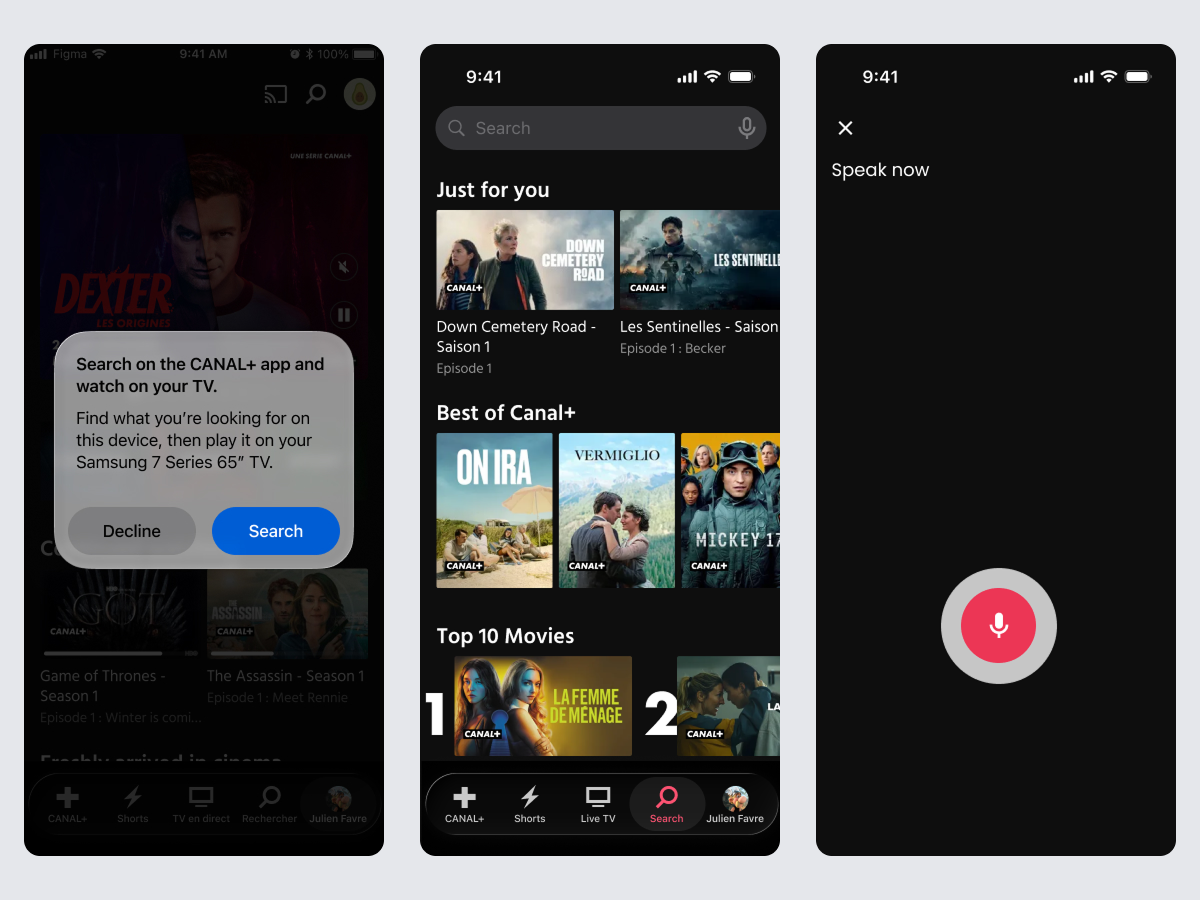
When a user selects the search bar on the TV, their phone receives a notification letting them know they can now search from their phone instead, using either text or voice input. The TV remains the display surface, but the phone becomes the input surface, replacing slow remote-and-keyboard typing with the kind of fast, familiar typing or speech people already use every day.
Notification triggered on selection
Tapping the TV search bar sends an instant phone notification, so the handoff to mobile input feels like a natural next step, not a separate setup process.
Text or voice, user's choice
Once on the phone, users can type using a full keyboard or speak their search, both far faster than remote-based input.
An accessibility win, not just a convenience one
For users with limited dexterity or difficulty with small on-screen keyboards, moving input to a familiar phone keyboard or voice removes a major barrier to finding content.
Solutions Concept 2: Hand Gestures
Some actions don't need a remote at all.
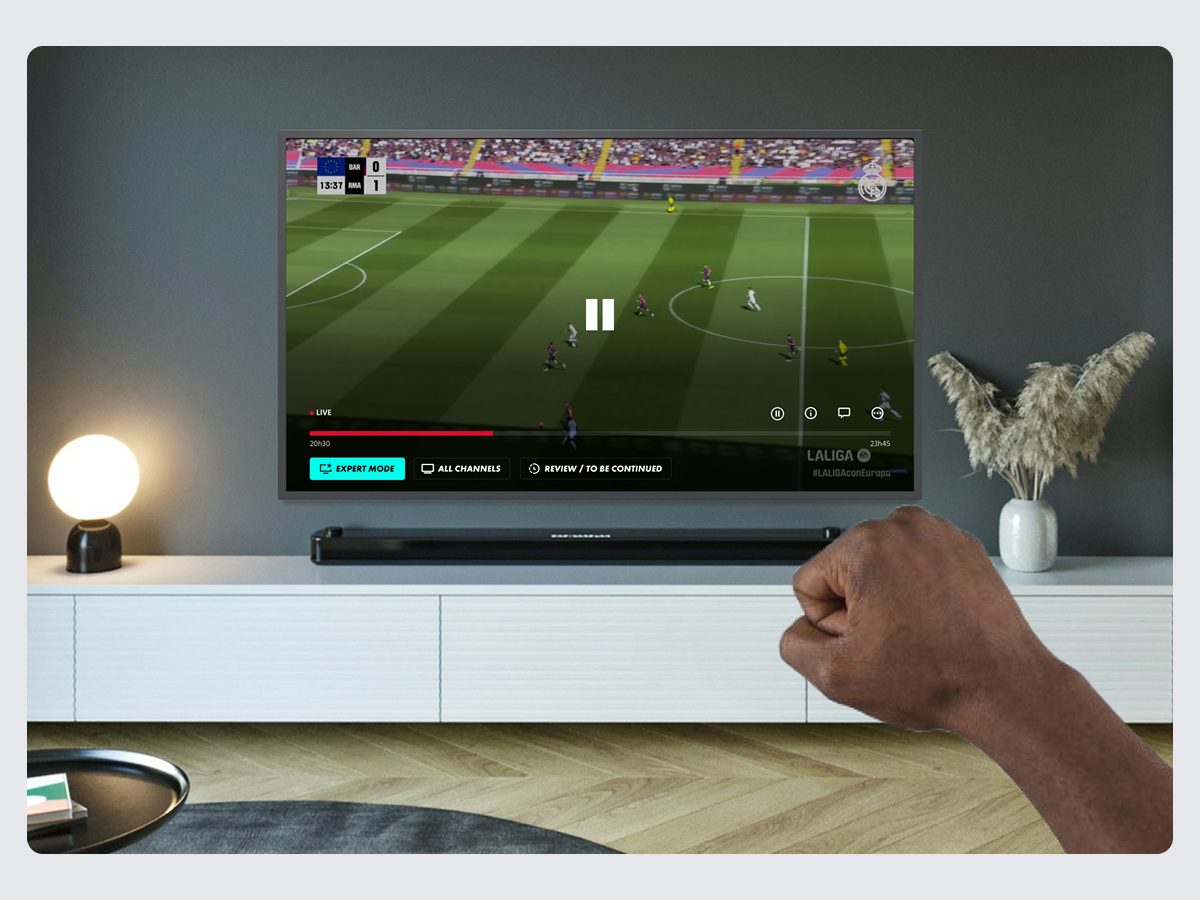
Hand Gestures lets users perform the most common remote actions using hand movements alone, no device in hand required. The gesture set was kept deliberately small, covering only the actions people reach for most during everyday viewing:
Volume: increase & decrease
A directional gesture adjusts volume up or down without touching a remote.
Playback: pause & play
A single clear gesture toggles playback, covering the most frequent in-session action.
Navigation: rewind & fast-forward
Directional gestures let users skip back or ahead, mirroring the most-used remote buttons.
Keeping the gesture vocabulary limited to these six actions meant the system stayed easy to learn and remember and like Mobile Companion, it doubles as an accessibility feature, giving users who struggle to hold or operate a small remote a viable alternative way to control their viewing.
An alternative considered
Why not just redesign the remote itself?
An earlier direction explored simplifying the physical remote — fewer buttons, better grouping, clearer iconography. It was a reasonable fix, but it was still a fix to the same object causing the frustration in the first place. It also did nothing for the typing problem, which was the more acute pain point in the research.
We moved away from this in favour of Mobile Companion and Hand Gestures because both removed the remote from the equation entirely for their respective tasks, rather than making a flawed input device marginally less flawed.
Outcomes
Two concepts, one shared win.
Both concepts addressed the brief from a different angle — one rethinking input for search, the other rethinking control for playback, but landed on the same underlying outcome: reducing dependency on the traditional remote made the experience better for everyone, and substantially more usable for people the existing remote-first design excluded. As a concept-stage initiative, the win here was strategic clarity rather than measured impact giving the business two distinct, accessibility-forward directions worth prototyping further.
Key learnings
01
Accessibility and convenience are often the same fix. Neither concept was framed as an accessibility feature first, yet both ended up being the strongest accessibility improvement available, because removing friction for everyone tends to remove barriers for people with additional constraints too.
02
A heuristic evaluation earns its keep early. Spending time structurally reviewing the existing experience before designing anything new meant both concepts were aimed at real, evidenced friction points rather than assumptions.
03
Not every project needs a single solution. Splitting one brief into two parallel concepts, each solving a distinct friction point, was more honest to the research than forcing one feature to do both jobs.